resultiqo

Uncategorized

Uncategorized

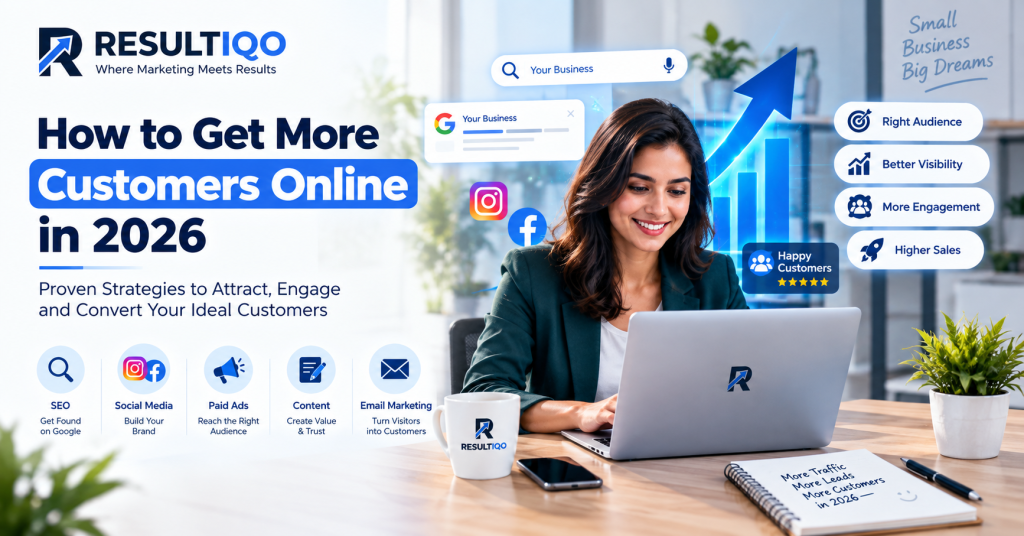
How to Get More Customers Online in 2026

Getting customers online has become an important part of growing a business. Whether you run a local shop, service-based company, e-commerce store, or professional agency, your customers are already using search engines, social media, websites, and online platforms to discover businesses. However, simply having a website or social media account is not enough. In 2026, businesses need a clear digital marketing strategy that helps them get discovered, build trust, and turn online visitors into paying customers. The good news is that you don’t necessarily need a huge marketing budget. By focusing on the right channels and consistently improving your online presence, even a small business can create opportunities to attract new customers. Here are some practical strategies to help you get more customers online in 2026. 1. Build a Strong Online Presence Before trying to attract customers, make sure your business can be easily found online. Start with a professional website that clearly explains what you offer, who you serve, and how customers can contact you. Your website should have simple navigation, clear calls to action, fast loading times, and a mobile-friendly design. For example, instead of simply writing “We provide marketing services,” a digital marketing agency could use a stronger message such as: “Grow Your Business With Data-Driven Digital Marketing.” Make it easy for visitors to take the next step, whether that means requesting a quote, booking a consultation, calling your business, or making a purchase. 2. Improve Your Google Visibility With SEO Search Engine Optimization, commonly known as SEO, can help your business appear when potential customers search for products or services related to your business. Start by identifying the keywords your customers are likely to search for. Then create useful website pages and content around those topics. For example, a local fitness business might target phrases such as: SEO isn’t only about adding keywords. Your website should provide genuinely useful information and a good experience for visitors. For local businesses, local SEO is particularly important. Keep your business information accurate and consistent across relevant online platforms and encourage genuine customer reviews. 3. Use Social Media to Build Relationships Social media platforms can help businesses reach potential customers while building familiarity and trust. Instead of using social media only to promote products, create content that provides value. You can share: Short-form video can also be incorporated into your content strategy where it fits your audience and business. The goal is to give people a reason to follow your brand and remember your business when they eventually need your product or service. 4. Create Content That Answers Customer Questions One of the most effective ways to attract potential customers is to create content around the questions they are already asking. Think about the problems your customers face before they purchase from you. For example, a web design company could publish: “How Much Does a Business Website Cost in 2026?” A digital marketing agency could publish: “Google Ads vs Meta Ads: Which Should Your Business Use?” A furniture company could create: “How to Choose the Right Sofa for a Small Living Room.” This type of content can attract people during the research stage and introduce them to your brand before they are ready to buy. 5. Use Google Ads to Capture Existing Demand Sometimes potential customers are already searching for exactly what your business provides. For example, someone searching for “digital marketing agency near me” may already be looking for a service provider. Google Ads can help businesses appear in front of people searching for relevant products and services. However, successful advertising requires more than simply creating an advertisement. Your campaign should have: Start with a controlled budget and use campaign data to understand what is working. 6. Use Meta Ads to Reach New Audiences Facebook and Instagram advertising can help businesses introduce their products or services to people who may not be actively searching for them. Meta Ads can be particularly useful for visually appealing products, promotions, brand awareness, lead generation, and remarketing campaigns. For example, an online clothing store could use engaging product videos and images to introduce its collection to relevant audiences. The key is to combine good targeting with strong creative content and a clear offer. 7. Build Trust With Reviews and Testimonials People often want reassurance before buying from a business they don’t know. Customer reviews, testimonials, case studies, and examples of previous work can help demonstrate credibility. Ask satisfied customers to leave genuine reviews on appropriate platforms. You can also feature selected testimonials on your website and social media channels. For service-based businesses, case studies can be especially useful because they show potential customers what you actually achieved for previous clients. 8. Create a Clear Conversion Strategy Getting website visitors is only one part of digital marketing. You also need to convert those visitors into leads or customers. Every important page on your website should have a clear next step. Examples include: Get a Free Consultation Request a Quote Book a Call Shop Now Contact Us Avoid overwhelming visitors with too many options. Make the desired action obvious and easy to complete. 9. Retarget Potential Customers Not everyone will become a customer during their first visit. Someone might visit your website, look at your services, and leave without contacting you. Retargeting can help businesses reconnect with people who have already interacted with their website, content, or advertising, where appropriate and subject to platform rules and privacy requirements. This can be useful because the person has already shown some interest in your business. 10. Measure Your Digital Marketing Results One of the biggest advantages of digital marketing is the ability to measure performance. Don’t focus only on likes and followers. Track metrics that connect with your actual business goals. These can include: Review your results regularly and use the data to improve your campaigns. Final Thoughts Learning how to get more customers online in 2026 isn’t about using every available digital marketing channel. It’s about understanding your audience, choosing the right platforms, providing valuable […]
Uncategorized

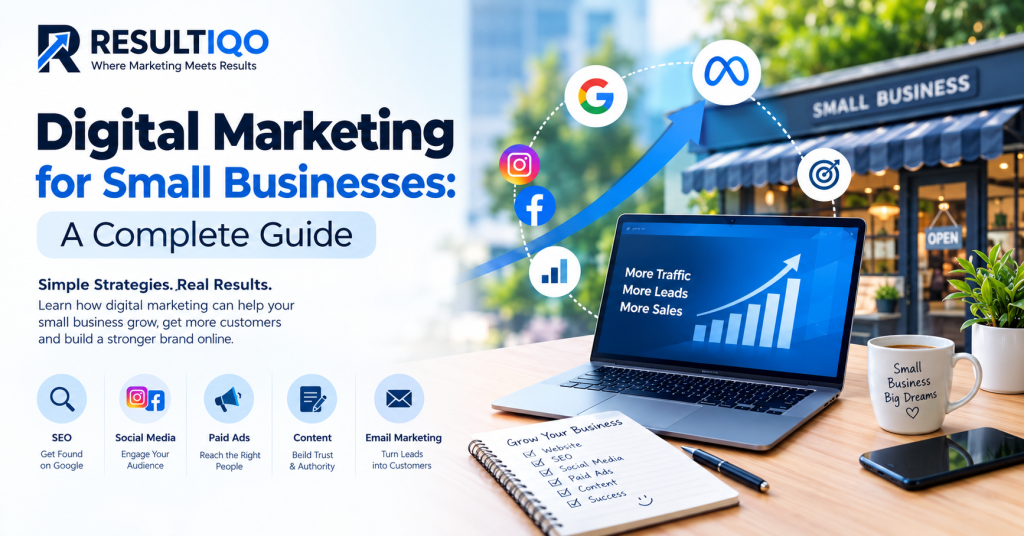
Digital Marketing for Small Businesses: A Complete Guide

In today’s competitive business environment, having a great product or service is not always enough to attract customers. Small businesses need to build an online presence, reach the right audience, and communicate their value effectively. This is where digital marketing for small businesses becomes important. From search engines and social media to email campaigns and online advertising, digital marketing gives small businesses multiple ways to connect with potential customers. Unlike traditional marketing, digital strategies can be measured, adjusted, and scaled according to a business’s goals and budget. In this complete guide, we will explore the most important digital marketing strategies that small businesses can use to increase visibility, generate leads, and build long-term customer relationships. What Is Digital Marketing for Small Businesses? Digital marketing refers to promoting a business, product, or service through online channels. These channels can include search engines, social media platforms, websites, email, online advertisements, and content. For small businesses, digital marketing can provide an opportunity to compete for attention in their target market without relying entirely on expensive traditional advertising. For example, a local restaurant can use Google search visibility, social media content, online reviews, and paid advertising to attract customers. Similarly, a service-based business can use SEO, blogs, Google Ads, and landing pages to generate leads. The key is to choose strategies that match the business’s target audience and objectives. Why Is Digital Marketing Important for Small Businesses? One of the biggest advantages of digital marketing is the ability to reach specific audiences. Traditional advertising can sometimes make it difficult to determine exactly who saw an advertisement and what action they took afterward. Digital marketing provides businesses with tools to track important metrics such as website visits, clicks, leads, conversions, engagement, and advertising performance. Digital marketing can help small businesses: However, simply being present online is not enough. Businesses need a well-planned strategy. 1. Build a Professional Business Website Your website is often one of the first places potential customers visit when they discover your business. A professional website should clearly communicate: Your website should also be mobile-friendly, easy to navigate, fast, and designed around the customer experience. For example, a digital marketing agency might include separate pages for SEO, social media marketing, Google Ads, content marketing, and other services. Each page can target a specific audience and search intent. 2. Focus on Search Engine Optimization Search Engine Optimization (SEO) helps businesses improve their visibility in search engine results. When someone searches for a product or service related to your business, appearing prominently in search results can bring valuable organic traffic to your website. Small businesses can start with basic SEO activities such as: Local businesses should also pay attention to local SEO, especially if customers visit a physical location or services are offered within a specific geographic area. 3. Use Social Media Marketing Social media gives small businesses a way to communicate directly with their audience. Depending on the target audience, businesses may use platforms such as Instagram, Facebook, LinkedIn, YouTube, or other relevant channels. Effective social media content can include: The goal should not always be to sell. Providing useful and engaging content can help businesses develop trust and maintain an active relationship with their audience. 4. Try Paid Online Advertising Organic marketing can take time, while paid advertising can help businesses reach potential customers more quickly. Platforms such as Google Ads and Meta Ads allow businesses to create targeted advertising campaigns. Google Ads can help businesses reach people who are actively searching for specific products or services. Meta Ads can help businesses reach audiences based on factors such as interests, demographics, behaviors, and engagement. The right advertising platform depends on the business, target audience, campaign objective, and budget. Most importantly, businesses should track results instead of simply measuring how many people saw an advertisement. 5. Create Valuable Content Content marketing is another important part of digital marketing for small businesses. A business can create blogs, guides, videos, social media posts, case studies, FAQs, and other useful resources based on the questions its customers commonly ask. For example, a home renovation company could publish articles such as: This type of content can attract people who are researching a problem and may eventually become customers. 6. Build Your Online Reputation Online reviews can influence how potential customers perceive a business. Encourage satisfied customers to share genuine feedback on relevant platforms. Businesses should also respond professionally to customer reviews and address concerns where appropriate. A strong online reputation can support trust, particularly for local businesses and service providers. 7. Track and Improve Your Results One of the most important parts of digital marketing is measuring performance. Businesses should identify key performance indicators (KPIs) based on their objectives. These may include: Tracking these metrics helps businesses understand which activities are producing useful results and where improvements may be needed. Creating a Simple Digital Marketing Strategy Small businesses don’t need to use every digital marketing channel at once. A better approach is to start with a clear plan. First, identify your target audience and understand their needs. Then define your primary goal, such as increasing website traffic, generating leads, increasing sales, or improving brand awareness. Next, select the channels that are most relevant to your audience. Create useful content, optimize your website, promote your business where appropriate, and regularly review your results. Digital marketing is an ongoing process. Strategies that work today may need to be adjusted as customer behavior, technology, and competition change. Final Thoughts Digital marketing for small businesses can provide a practical way to increase visibility, reach potential customers, generate leads, and build a stronger brand online. A successful strategy does not necessarily require a huge budget. What matters is having clear goals, understanding your audience, creating valuable content, choosing the right marketing channels, and consistently measuring performance. From SEO and social media to paid advertising and content marketing, small businesses can combine different strategies to create a digital presence that supports long-term growth. At RESULTIQO, our approach is focused on helping businesses […]

Uncategorized

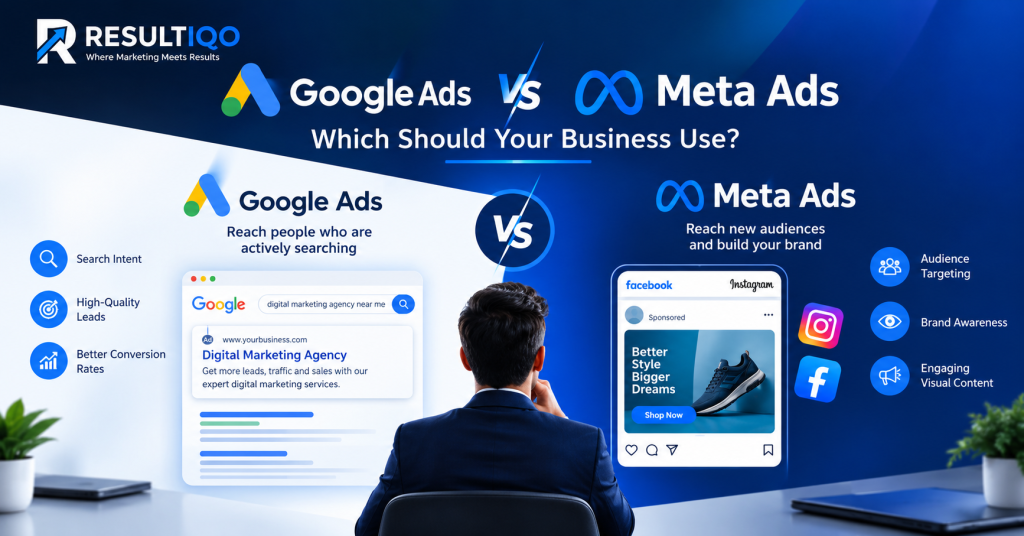
Google Ads vs Meta Ads: Which Should Your Business Use?

In today’s competitive digital landscape, businesses need more than just a good product or service to attract customers. Reaching the right audience at the right time has become essential for generating leads, sales, and long-term growth. This is where paid advertising platforms such as Google Ads and Meta Ads can make a significant difference. Both platforms can help businesses reach potential customers online, but they work in different ways. Google Ads primarily connects businesses with people who are actively searching for products or services, while Meta Ads helps businesses reach people based on their interests, behavior, demographics, and online activity. So, Google Ads vs Meta Ads — which should your business use? The answer depends on your business goals, target audience, budget, product or service, and marketing strategy. What Are Google Ads? Google Ads is Google’s online advertising platform. Businesses can create advertisements that appear across Google’s search results, YouTube, and other Google properties. One of the biggest advantages of Google Ads is search intent. When someone searches for terms such as “digital marketing agency near me” or “best running shoes,” they are already showing an interest in a particular product or service. For example, a digital marketing agency could target keywords related to: This allows businesses to connect with users who may already be looking for what they offer. What Are Meta Ads? Meta Ads are advertisements that businesses run across platforms such as Facebook and Instagram. Unlike Google Search Ads, Meta Ads generally don’t depend on someone actively searching for a product. Instead, advertisers can target audiences using factors such as demographics, interests, behaviors, location, and engagement. For example, a fashion brand could show Instagram ads to people interested in fashion, online shopping, clothing brands, or related topics. Meta Ads are particularly useful for building awareness, generating interest, promoting products, and reaching new audiences. Google Ads vs Meta Ads: Key Differences The biggest difference between the two platforms is the way users are reached. Google Ads focuses heavily on intent, while Meta Ads focuses heavily on audience targeting and discovery. Imagine someone searching Google for “best digital marketing agency in Delhi.” They have already identified a need and are actively looking for a solution. On the other hand, someone scrolling through Instagram may not be looking for a digital marketing agency at that moment. However, they may see an interesting advertisement explaining how businesses can increase leads through digital marketing and become interested. Both approaches can be valuable, but they serve different stages of the customer journey. Which Platform Is Better for Lead Generation? The right platform depends on your industry and the type of lead you want. Google Ads can be useful when people are actively searching for your services. Businesses such as lawyers, plumbers, dentists, marketing agencies, repair companies, and other service providers may benefit from search-based advertising because potential customers often search when they already need a solution. Meta Ads can also generate leads, particularly when businesses use compelling creative content, strong offers, lead forms, landing pages, or retargeting campaigns. Instead of asking which platform is universally better, businesses should ask: Where does my target audience spend time, and what are they doing before becoming a customer? Which Is Better for E-Commerce Businesses? For e-commerce businesses, both Google Ads and Meta Ads can play important roles. Google Ads can help capture people who are already searching for specific products. For example, someone searching for “buy wireless headphones online” has demonstrated strong purchase intent. Meta Ads can help introduce products to potential customers who may not have discovered the brand yet. High-quality product images, videos, Reels, and creative offers can be useful for attracting attention. A business can therefore use Google Ads to capture existing demand while using Meta Ads to create and develop new demand. Google Ads vs Meta Ads: Cost Advertising costs vary considerably depending on the industry, audience, competition, campaign objective, location, keywords, creative quality, and other factors. Google Ads may become expensive for highly competitive keywords because multiple advertisers compete for the same search terms. Meta Ads can provide businesses with flexible budget options, but performance also depends heavily on targeting, creative quality, offer, landing page experience, and campaign optimization. Instead of choosing a platform simply because it appears cheaper, businesses should focus on return on investment (ROI). A campaign that costs more per click can still be valuable if it generates high-quality customers and profitable sales. Should Your Business Use Google Ads or Meta Ads? Consider Google Ads when: Consider Meta Ads when: For many businesses, using both platforms together can create a more complete digital marketing strategy. Why Using Both Platforms Can Be Effective Google Ads and Meta Ads don’t necessarily have to compete with each other. A potential customer might first discover your brand through an Instagram advertisement. Later, they may search for your business on Google and visit your website. Eventually, they may return through a remarketing campaign and make a purchase. This means different advertising platforms can support different stages of the customer journey. For example: Meta Ads → Brand Awareness → Website Visit → Google Search → Retargeting → Conversion The exact customer journey will vary by business, but combining platforms can help businesses reach customers at different stages. Final Thoughts There is no single answer to Google Ads vs Meta Ads because every business has different objectives, audiences, products, and budgets. Google Ads can be valuable for capturing existing search demand and reaching users with strong purchase or service intent. Meta Ads can be useful for discovering new audiences, building awareness, and using engaging visual content to generate interest. The most effective approach is to understand your target audience first and then choose the platform that matches their behavior. If your business needs help creating a paid advertising strategy, RESULTIQO can help you build a data-driven digital marketing approach focused on reaching the right audience, generating quality leads, and improving campaign performance. Where Marketing Meets Results.

Uncategorized

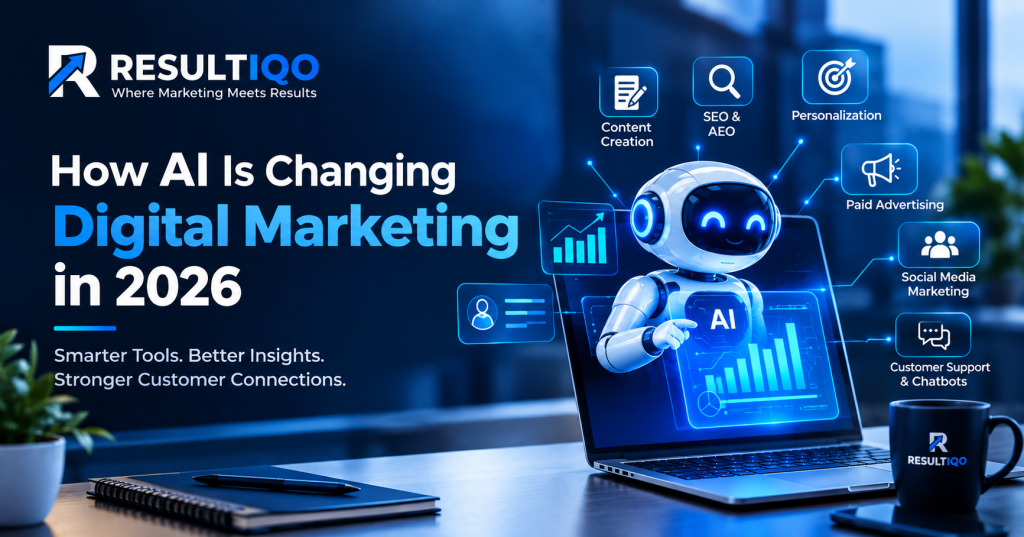
How AI Is Changing Digital Marketing in 2026

Digital marketing is changing faster than ever, and Artificial Intelligence (AI) is one of the biggest reasons behind this transformation. From creating content and analyzing customer behavior to improving advertising campaigns and answering search queries, AI is becoming an important part of modern marketing. In 2026, businesses are no longer using AI only as an experimental technology. It is becoming part of everyday marketing strategies. Companies of all sizes can use AI to understand their audiences, automate repetitive tasks, personalize customer experiences, and make better data-driven decisions. For businesses looking to remain competitive online, understanding how AI is changing digital marketing is becoming increasingly important. What Is AI in Digital Marketing? AI in digital marketing refers to using artificial intelligence technologies to analyze information, recognize patterns, automate tasks, and support marketing decisions. AI-powered tools can process large amounts of data much faster than humans. They can help marketers understand what customers are searching for, which content they prefer, how they interact with websites, and which advertising messages are more likely to attract attention. However, AI does not necessarily replace marketers. Instead, it can act as a powerful assistant that helps marketing teams work more efficiently and make better-informed decisions. 1. AI Is Transforming Content Creation Content remains one of the most important parts of digital marketing, but creating high-quality content consistently requires considerable time and effort. AI tools can help marketers generate content ideas, create outlines, summarize information, write initial drafts, and adapt content for different platforms. For example, a digital marketing team can use AI to brainstorm blog topics based on customer questions or create different versions of a social media caption. However, businesses should not depend completely on AI-generated content. Human creativity, expertise, fact-checking, brand voice, and original insights are still essential. The most effective approach is often AI-assisted content creation, where AI helps with speed and research while humans remain responsible for quality and strategy. 2. AI Is Changing Search and SEO Search behavior is also evolving because of AI. People increasingly use conversational questions instead of short keywords when looking for information. AI-powered search experiences can provide direct answers, summaries, recommendations, and links to relevant websites. This means businesses need to think beyond traditional keyword optimization. Modern SEO strategies increasingly focus on creating useful, trustworthy, well-structured content that clearly answers users’ questions. Businesses also need to consider areas such as Answer Engine Optimization (AEO) and optimization for AI-driven search experiences. Instead of creating content only to rank for a keyword, marketers should focus on answering the real questions their target audience is asking. 3. Personalized Marketing Is Becoming More Powerful Customers expect brands to provide relevant experiences. Showing the same message to every customer is becoming less effective. AI can analyze customer interactions, browsing behavior, purchase history, and other marketing data to help businesses understand different audience segments. For example, an online store can use customer behavior to recommend products that may be relevant to an individual visitor. Similarly, marketers can create different email campaigns or advertising messages for different audience groups. This type of personalization can make marketing communication more relevant and help businesses build stronger relationships with customers. 4. AI Is Improving Digital Advertising Paid advertising is another area being significantly influenced by AI. Advertising platforms increasingly use machine learning and automation to help businesses identify audiences, optimize campaigns, allocate budgets, and improve ad performance. AI can analyze large amounts of campaign data and identify patterns that may not be immediately obvious to marketers. For example, AI-powered systems can help determine which audiences, placements, creatives, or times may produce better results. However, successful advertising still requires human strategy. Marketers need to define business goals, understand the target audience, develop strong creative concepts, and monitor campaign performance. AI can improve optimization, but it should work alongside a clear marketing strategy. 5. AI Is Making Customer Support Faster Customers want quick answers, especially when they have questions about products, services, pricing, or order status. AI-powered chatbots and virtual assistants can provide automated responses to common questions at any time of the day. For a digital marketing agency, this can also be useful for handling initial website inquiries. An AI assistant can collect basic information from visitors before a human team member takes over the conversation. This can reduce repetitive work while allowing businesses to respond to potential customers more quickly. The key is to create a balance between automation and human support. Complex or sensitive questions should still be handled by people. 6. AI Is Helping Marketers Make Better Decisions Digital marketing generates enormous amounts of data. Businesses can collect information from websites, social media, email campaigns, search engines, advertising platforms, and customer interactions. The challenge is turning this data into useful insights. AI can help marketers identify patterns, analyze campaign performance, segment audiences, and detect changes in customer behavior. Instead of spending hours manually reviewing large datasets, marketers can use AI-powered analytics tools to find useful information more efficiently. This allows marketing teams to spend more time on strategy and creative decision-making. 7. AI Is Changing Social Media Marketing Social media teams have to manage multiple platforms, create content, analyze engagement, respond to users, and monitor trends. AI can support many of these activities. Marketers can use AI to generate content ideas, identify potential trends, analyze audience engagement, repurpose content, and assist with social media scheduling. For example, one long-form blog can be transformed into social media posts, short video ideas, email content, and other marketing assets. This can help businesses maintain a more consistent presence across multiple channels. The Importance of Human Creativity While AI is becoming more powerful, successful digital marketing still depends on human creativity and understanding. AI can analyze data and generate ideas, but marketers provide brand personality, emotional understanding, strategic thinking, and real-world context. Businesses that simply publish large amounts of AI-generated content may struggle to stand out. The future is more likely to belong to businesses that combine AI efficiency with human creativity. How Businesses Can Prepare for […]

Scroll to Top