In today’s competitive digital landscape, businesses need more than just a good product or service to attract customers. Reaching the right audience at the right time has become essential for generating leads, sales, and long-term growth. This is where paid advertising platforms such as Google Ads and Meta Ads can make a significant difference.
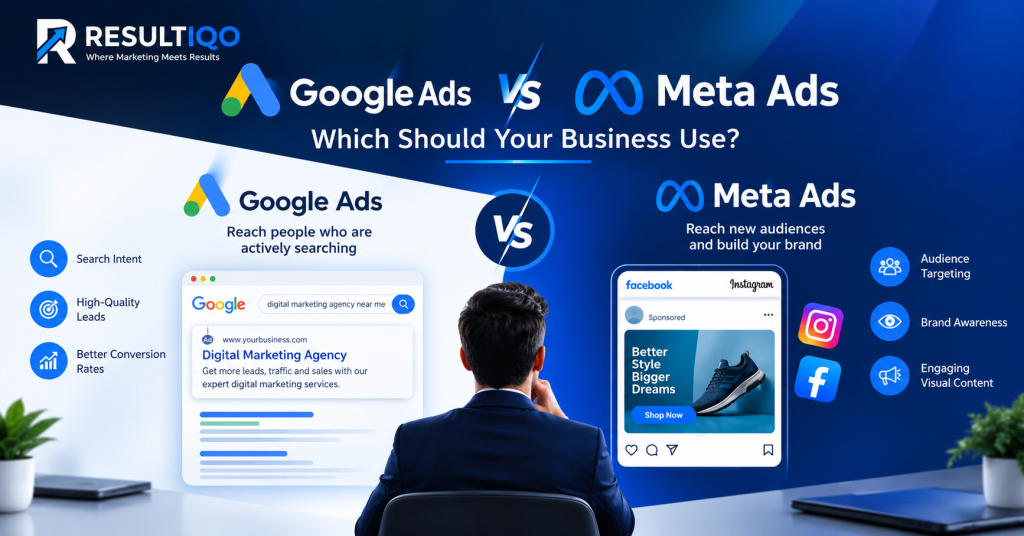
Both platforms can help businesses reach potential customers online, but they work in different ways. Google Ads primarily connects businesses with people who are actively searching for products or services, while Meta Ads helps businesses reach people based on their interests, behavior, demographics, and online activity.
So, Google Ads vs Meta Ads — which should your business use? The answer depends on your business goals, target audience, budget, product or service, and marketing strategy.
What Are Google Ads?
Google Ads is Google’s online advertising platform. Businesses can create advertisements that appear across Google’s search results, YouTube, and other Google properties.
One of the biggest advantages of Google Ads is search intent. When someone searches for terms such as “digital marketing agency near me” or “best running shoes,” they are already showing an interest in a particular product or service.
For example, a digital marketing agency could target keywords related to:
- Digital marketing agency
- SEO services
- Google Ads management
- Social media marketing agency
- Digital marketing services for small businesses
This allows businesses to connect with users who may already be looking for what they offer.
What Are Meta Ads?
Meta Ads are advertisements that businesses run across platforms such as Facebook and Instagram.
Unlike Google Search Ads, Meta Ads generally don’t depend on someone actively searching for a product. Instead, advertisers can target audiences using factors such as demographics, interests, behaviors, location, and engagement.
For example, a fashion brand could show Instagram ads to people interested in fashion, online shopping, clothing brands, or related topics.
Meta Ads are particularly useful for building awareness, generating interest, promoting products, and reaching new audiences.
Google Ads vs Meta Ads: Key Differences
The biggest difference between the two platforms is the way users are reached.
Google Ads focuses heavily on intent, while Meta Ads focuses heavily on audience targeting and discovery.
Imagine someone searching Google for “best digital marketing agency in Delhi.” They have already identified a need and are actively looking for a solution.
On the other hand, someone scrolling through Instagram may not be looking for a digital marketing agency at that moment. However, they may see an interesting advertisement explaining how businesses can increase leads through digital marketing and become interested.
Both approaches can be valuable, but they serve different stages of the customer journey.
Which Platform Is Better for Lead Generation?
The right platform depends on your industry and the type of lead you want.
Google Ads can be useful when people are actively searching for your services. Businesses such as lawyers, plumbers, dentists, marketing agencies, repair companies, and other service providers may benefit from search-based advertising because potential customers often search when they already need a solution.
Meta Ads can also generate leads, particularly when businesses use compelling creative content, strong offers, lead forms, landing pages, or retargeting campaigns.
Instead of asking which platform is universally better, businesses should ask:
Where does my target audience spend time, and what are they doing before becoming a customer?
Which Is Better for E-Commerce Businesses?
For e-commerce businesses, both Google Ads and Meta Ads can play important roles.
Google Ads can help capture people who are already searching for specific products. For example, someone searching for “buy wireless headphones online” has demonstrated strong purchase intent.
Meta Ads can help introduce products to potential customers who may not have discovered the brand yet. High-quality product images, videos, Reels, and creative offers can be useful for attracting attention.
A business can therefore use Google Ads to capture existing demand while using Meta Ads to create and develop new demand.
Google Ads vs Meta Ads: Cost
Advertising costs vary considerably depending on the industry, audience, competition, campaign objective, location, keywords, creative quality, and other factors.
Google Ads may become expensive for highly competitive keywords because multiple advertisers compete for the same search terms.
Meta Ads can provide businesses with flexible budget options, but performance also depends heavily on targeting, creative quality, offer, landing page experience, and campaign optimization.
Instead of choosing a platform simply because it appears cheaper, businesses should focus on return on investment (ROI).
A campaign that costs more per click can still be valuable if it generates high-quality customers and profitable sales.
Should Your Business Use Google Ads or Meta Ads?
Consider Google Ads when:
- Customers actively search for your product or service.
- Your business provides a solution to an existing need.
- You want to capture high-intent traffic.
- Search keywords are important to your industry.
- You have a strong landing page or website.
Consider Meta Ads when:
- Your product is highly visual.
- You want to build brand awareness.
- Your audience is active on Facebook or Instagram.
- You want to reach new potential customers.
- You have strong images, videos, Reels, or promotional content.
For many businesses, using both platforms together can create a more complete digital marketing strategy.
Why Using Both Platforms Can Be Effective
Google Ads and Meta Ads don’t necessarily have to compete with each other.
A potential customer might first discover your brand through an Instagram advertisement. Later, they may search for your business on Google and visit your website. Eventually, they may return through a remarketing campaign and make a purchase.
This means different advertising platforms can support different stages of the customer journey.
For example:
Meta Ads → Brand Awareness → Website Visit → Google Search → Retargeting → Conversion
The exact customer journey will vary by business, but combining platforms can help businesses reach customers at different stages.
Final Thoughts
There is no single answer to Google Ads vs Meta Ads because every business has different objectives, audiences, products, and budgets.
Google Ads can be valuable for capturing existing search demand and reaching users with strong purchase or service intent. Meta Ads can be useful for discovering new audiences, building awareness, and using engaging visual content to generate interest.
The most effective approach is to understand your target audience first and then choose the platform that matches their behavior.
If your business needs help creating a paid advertising strategy, RESULTIQO can help you build a data-driven digital marketing approach focused on reaching the right audience, generating quality leads, and improving campaign performance.
Where Marketing Meets Results.