
Digital marketing is changing faster than ever, and Artificial Intelligence (AI) is one of the biggest reasons behind this transformation. From creating content and analyzing customer behavior to improving advertising campaigns and answering search queries, AI is becoming an important part of modern marketing.
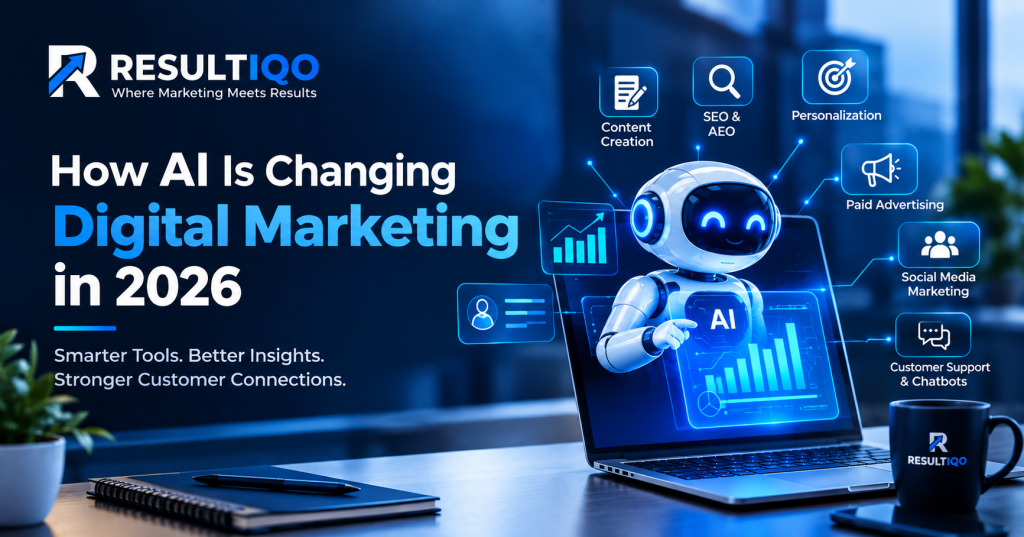
In 2026, businesses are no longer using AI only as an experimental technology. It is becoming part of everyday marketing strategies. Companies of all sizes can use AI to understand their audiences, automate repetitive tasks, personalize customer experiences, and make better data-driven decisions.
For businesses looking to remain competitive online, understanding how AI is changing digital marketing is becoming increasingly important.
What Is AI in Digital Marketing?
AI in digital marketing refers to using artificial intelligence technologies to analyze information, recognize patterns, automate tasks, and support marketing decisions.
AI-powered tools can process large amounts of data much faster than humans. They can help marketers understand what customers are searching for, which content they prefer, how they interact with websites, and which advertising messages are more likely to attract attention.
However, AI does not necessarily replace marketers. Instead, it can act as a powerful assistant that helps marketing teams work more efficiently and make better-informed decisions.
1. AI Is Transforming Content Creation
Content remains one of the most important parts of digital marketing, but creating high-quality content consistently requires considerable time and effort.
AI tools can help marketers generate content ideas, create outlines, summarize information, write initial drafts, and adapt content for different platforms.
For example, a digital marketing team can use AI to brainstorm blog topics based on customer questions or create different versions of a social media caption.
However, businesses should not depend completely on AI-generated content. Human creativity, expertise, fact-checking, brand voice, and original insights are still essential.
The most effective approach is often AI-assisted content creation, where AI helps with speed and research while humans remain responsible for quality and strategy.
2. AI Is Changing Search and SEO
Search behavior is also evolving because of AI.
People increasingly use conversational questions instead of short keywords when looking for information. AI-powered search experiences can provide direct answers, summaries, recommendations, and links to relevant websites.
This means businesses need to think beyond traditional keyword optimization.
Modern SEO strategies increasingly focus on creating useful, trustworthy, well-structured content that clearly answers users’ questions. Businesses also need to consider areas such as Answer Engine Optimization (AEO) and optimization for AI-driven search experiences.
Instead of creating content only to rank for a keyword, marketers should focus on answering the real questions their target audience is asking.
3. Personalized Marketing Is Becoming More Powerful
Customers expect brands to provide relevant experiences. Showing the same message to every customer is becoming less effective.
AI can analyze customer interactions, browsing behavior, purchase history, and other marketing data to help businesses understand different audience segments.
For example, an online store can use customer behavior to recommend products that may be relevant to an individual visitor.
Similarly, marketers can create different email campaigns or advertising messages for different audience groups.
This type of personalization can make marketing communication more relevant and help businesses build stronger relationships with customers.
4. AI Is Improving Digital Advertising
Paid advertising is another area being significantly influenced by AI.
Advertising platforms increasingly use machine learning and automation to help businesses identify audiences, optimize campaigns, allocate budgets, and improve ad performance.
AI can analyze large amounts of campaign data and identify patterns that may not be immediately obvious to marketers.
For example, AI-powered systems can help determine which audiences, placements, creatives, or times may produce better results.
However, successful advertising still requires human strategy. Marketers need to define business goals, understand the target audience, develop strong creative concepts, and monitor campaign performance.
AI can improve optimization, but it should work alongside a clear marketing strategy.
5. AI Is Making Customer Support Faster
Customers want quick answers, especially when they have questions about products, services, pricing, or order status.
AI-powered chatbots and virtual assistants can provide automated responses to common questions at any time of the day.
For a digital marketing agency, this can also be useful for handling initial website inquiries. An AI assistant can collect basic information from visitors before a human team member takes over the conversation.
This can reduce repetitive work while allowing businesses to respond to potential customers more quickly.
The key is to create a balance between automation and human support. Complex or sensitive questions should still be handled by people.
6. AI Is Helping Marketers Make Better Decisions
Digital marketing generates enormous amounts of data.
Businesses can collect information from websites, social media, email campaigns, search engines, advertising platforms, and customer interactions.
The challenge is turning this data into useful insights.
AI can help marketers identify patterns, analyze campaign performance, segment audiences, and detect changes in customer behavior.
Instead of spending hours manually reviewing large datasets, marketers can use AI-powered analytics tools to find useful information more efficiently.
This allows marketing teams to spend more time on strategy and creative decision-making.
7. AI Is Changing Social Media Marketing
Social media teams have to manage multiple platforms, create content, analyze engagement, respond to users, and monitor trends.
AI can support many of these activities.
Marketers can use AI to generate content ideas, identify potential trends, analyze audience engagement, repurpose content, and assist with social media scheduling.
For example, one long-form blog can be transformed into social media posts, short video ideas, email content, and other marketing assets.
This can help businesses maintain a more consistent presence across multiple channels.
The Importance of Human Creativity
While AI is becoming more powerful, successful digital marketing still depends on human creativity and understanding.
AI can analyze data and generate ideas, but marketers provide brand personality, emotional understanding, strategic thinking, and real-world context.
Businesses that simply publish large amounts of AI-generated content may struggle to stand out.
The future is more likely to belong to businesses that combine AI efficiency with human creativity.
How Businesses Can Prepare for AI-Driven Marketing
Businesses do not need to adopt every AI tool available. Instead, they should identify areas where AI can solve genuine problems.
Start by identifying repetitive marketing tasks that consume significant time. These might include content research, reporting, customer FAQs, data analysis, or content repurposing.
Next, introduce AI tools into those workflows while maintaining human review and quality control.
Businesses should also invest in strong first-party data, clear brand guidelines, high-quality content, and a well-defined digital marketing strategy.
Conclusion
AI is changing digital marketing in 2026 by making marketing more automated, personalized, data-driven, and responsive.
From SEO and content creation to paid advertising, customer support, analytics, and social media, AI is becoming part of many marketing workflows.
But AI should not be viewed simply as a replacement for marketers. Its greatest value comes from helping people work faster, understand customers better, and make more informed decisions.
For businesses, the goal should not be to use AI just because it is trending. The goal should be to use AI where it creates meaningful value while maintaining human creativity, expertise, and authenticity.
At RESULTIQO, we believe successful digital marketing is about combining technology with the right strategy. As AI continues to evolve, businesses that learn how to use it effectively can create smarter and more relevant digital experiences for their audiences.