Artificial intelligence is changing the way businesses approach digital marketing. Tasks that once required hours of research, writing, design, analysis, and campaign management can now be assisted by AI-powered tools.
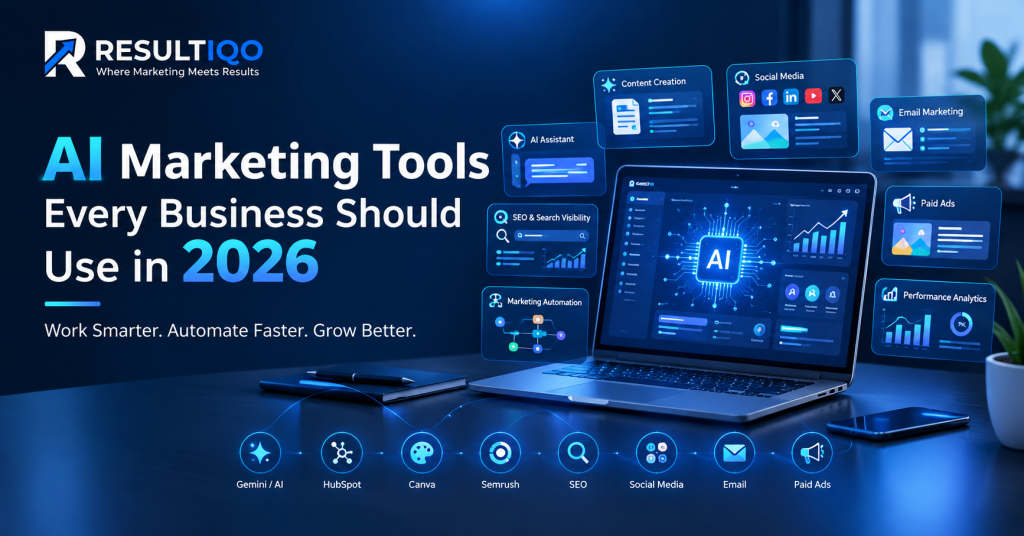
In 2026, AI is no longer limited to generating simple text or images. Modern marketing tools can help businesses research customers, create content, analyze data, personalize campaigns, improve search visibility, and automate repetitive workflows.
However, using AI effectively doesn’t mean replacing marketers with technology. The real opportunity is to use AI to work faster while keeping human strategy, creativity, brand knowledge, and quality control at the center.
In this guide, we will look at some of the most useful AI marketing tools for businesses in 2026 and explain how they can be used as part of a practical digital marketing strategy.
Why Are AI Marketing Tools Important in 2026?
Marketing involves many repetitive and time-consuming activities. Businesses need to research competitors, create content, manage social media, analyze campaigns, respond to customers, and constantly adapt their strategies.
AI can assist with many of these tasks.
For example, Google’s current Workspace with Gemini tools can help marketers create content, analyze information, research trends, brainstorm campaign ideas, and automate certain workflows. Google also recommends fact-checking AI-generated content rather than treating AI output as automatically accurate.
This means businesses can potentially spend less time on repetitive work and more time on strategy and customer relationships.
1. Google Gemini for Content and Marketing Research
Google Gemini is useful for businesses that need help with research, content creation, brainstorming, and analysis.
Marketing teams can use Gemini to help create:
- Blog outlines
- Social media captions
- Email drafts
- Marketing ideas
- Ad concepts
- Customer personas
- Campaign briefs
- Content repurposing ideas
Google’s marketing resources also highlight Gemini’s ability to support research, content creation, campaign ideation, data analysis, and workflow automation.
For example, a small business could ask Gemini to create ten content ideas around a specific customer problem and then turn the best ideas into blog posts, social media content, and email campaigns.
The important point is to review and customize AI-generated content before publishing it.
2. HubSpot Breeze for Marketing Automation
Businesses that use CRM and marketing automation can benefit from HubSpot Breeze.
HubSpot’s current Breeze Assistant can help generate and refine content, summarize records, prepare for meetings, and complete tasks within HubSpot.
It can also help marketers create content for pages, blog posts, knowledge bases, and calls-to-action.
This can be particularly useful for businesses that want to connect marketing activities with customer information.
For example, a business could use AI to help draft a lead-nurturing email, prepare a campaign idea, or create content based on information already available in its CRM.
3. Canva AI for Marketing Design
Visual content plays an important role in digital marketing. Businesses need social media posts, advertisements, presentations, banners, thumbnails, and other creative assets.
Canva’s AI-powered tools can help businesses accelerate the design process. Canva’s Magic Studio brings AI features into its design platform, with tools intended to help users generate content, develop ideas, automate tasks, and create designs without requiring advanced design skills.
For small businesses, this can be useful when creating:
- Instagram posts
- Facebook creatives
- Blog graphics
- Advertising banners
- Presentations
- Promotional designs
- Marketing materials
AI can help produce the first version, while a human can refine the design to match the brand’s colors, typography, messaging, and visual identity.
4. Semrush for SEO and AI Search Visibility
SEO is changing as people increasingly use AI-powered search experiences alongside traditional search engines.
Semrush provides SEO, content, competitor research, and AI visibility tools. Its current toolkit includes features for monitoring how brands appear in generative AI answers and understanding visibility across AI platforms.
Businesses can use tools like these to research keywords, analyze competitors, identify content opportunities, monitor website health, and understand how their brand appears in emerging AI search environments.
This is becoming increasingly relevant because businesses need to think beyond traditional rankings and consider how their brand is represented across different search experiences.
5. AI Tools for Social Media Content
Managing social media consistently can be challenging for small businesses.
AI can assist with brainstorming posts, creating captions, repurposing long-form content, and developing content calendars.
For example, one blog post can potentially be transformed into:
1 blog → 5 social posts → 2 short videos → 1 email → 1 infographic
This type of content repurposing allows businesses to get more value from the content they already create.
However, businesses should avoid publishing generic AI-generated posts without editing them. Authentic experiences, opinions, customer stories, and brand personality can make social content more distinctive.
6. AI for Paid Advertising
AI is also becoming increasingly integrated into advertising platforms.
Google has announced AI-powered developments for advertising in 2026, including new experiences in AI Mode and expanded use of AI in campaign formats.
Businesses can use AI-assisted advertising tools to help with areas such as:
- Ad copy variations
- Creative ideas
- Audience insights
- Campaign optimization
- Performance analysis
- Asset generation
But advertising decisions should still be guided by business objectives, customer data, budget, and campaign performance rather than blindly accepting automated recommendations.
7. AI for Email Marketing
Email marketing is another area where AI can save time.
Businesses can use AI to help create subject-line variations, email drafts, personalization ideas, customer segments, and follow-up sequences.
For example, an online store could create different email messages for:
- New customers
- Returning customers
- Abandoned-cart visitors
- Previous purchasers
- Inactive subscribers
Personalization can make email campaigns more relevant, but businesses should use customer data responsibly and follow applicable privacy requirements.
How to Choose the Right AI Marketing Tools
You don’t need to use every AI tool available.
Instead, identify your biggest marketing challenges first.
If your main problem is content creation, a generative AI assistant may be useful.
If your challenge is SEO, consider an SEO and AI-visibility platform.
If you need better design, an AI-powered design platform may be appropriate.
If you’re struggling with lead management and automation, a CRM with integrated AI capabilities may be more useful.
The goal should be to build a simple technology stack that solves real business problems rather than collecting dozens of tools.
AI Should Support Your Marketing Strategy, Not Replace It
One of the biggest mistakes businesses can make is assuming that AI automatically creates successful marketing.
It doesn’t.
AI can help generate ideas and accelerate execution, but businesses still need to understand their customers, define their positioning, create strong offers, check facts, protect customer information, and measure results.
Human creativity and strategic thinking remain essential.
The best approach is:
Strategy → AI Assistance → Human Review → Execution → Measurement → Optimization
This keeps technology working as part of the marketing process rather than becoming the strategy itself.
Final Thoughts
AI marketing tools in 2026 can help businesses save time, create content faster, analyze information, improve customer experiences, and automate repetitive marketing activities.
Tools such as Google Gemini, HubSpot Breeze, Canva AI, and Semrush demonstrate how AI is becoming integrated into content, CRM, design, SEO, and marketing workflows.
However, successful marketing still depends on understanding people and solving real customer problems.
Businesses should start with their goals, select tools that address specific needs, monitor their results, and continuously improve their approach.
At RESULTIQO, we help businesses combine digital marketing strategy, technology, creativity, and measurable performance to build a stronger online presence.
RESULTIQO — Where Marketing Meets Results.